What “Regenerative” means in Aesthetic Medicine: a narrative literature review attempting to demystify the core essence of regenerative aesthetics
- Francesca Arrigoni
- 1 giorno fa
- Tempo di lettura: 2 min

In recent years, the term “regenerative” has become firmly established in the language of aesthetic medicine, emerging as one of the most frequently used—and at the same time most ambiguous—concepts in clinical practice. Precisely to clarify what “regeneration” truly means in the aesthetic field, a narrative literature review has been published in Plastic and Aesthetic Research, analyzing the topic from a biological, clinical, and methodological perspective.
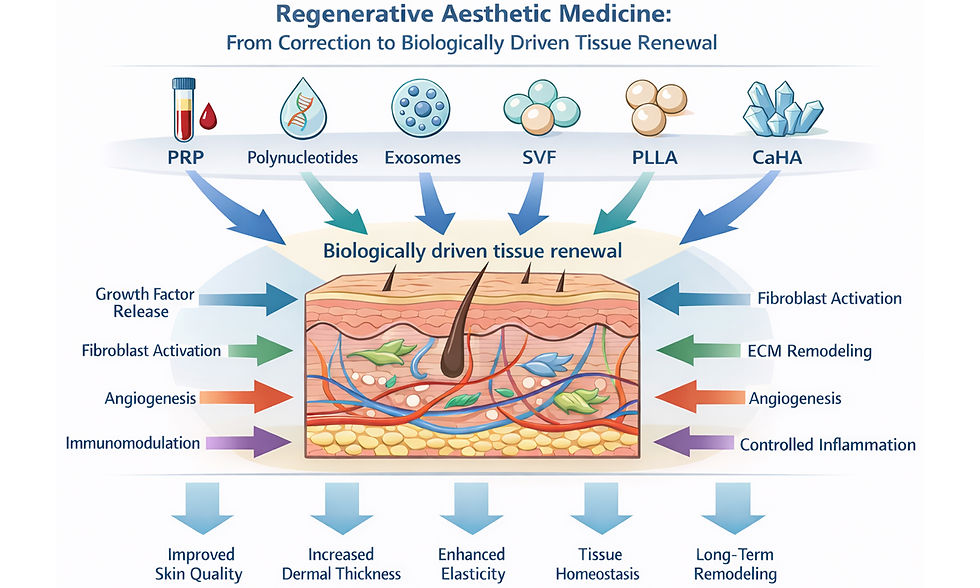
According to the authors, regenerative aesthetic medicine represents an evolution beyond a purely corrective approach: the goal is no longer limited to the immediate restoration of volume or the reduction of wrinkles, but rather to the progressive improvement of tissue quality through the stimulation of endogenous biological processes such as neocollagenesis, extracellular matrix remodeling, angiogenesis, and modulation of inflammation. Within this framework, the review critically examines the main injectable therapies currently associated with the concept of regeneration.
Platelet-Rich Plasma (PRP) is described as one of the most established and widely used techniques. Its rationale is based on the release of platelet-derived growth factors capable of stimulating fibroblasts, angiogenesis, and tissue repair. However, the authors emphasize that the considerable variability in preparation protocols, platelet concentration, and administration methods makes it difficult to compare study outcomes and to define shared clinical standards.
Polynucleotides are presented as biomolecules with a predominantly bio-revitalizing role and a supportive effect on cellular metabolism. They act by improving hydration, promoting fibroblast activity, and creating a microenvironment more conducive to tissue regeneration, with a favorable safety profile and increasingly widespread use in skin rejuvenation.
Significant attention is also devoted to exosomes, extracellular vesicles involved in intercellular communication. In aesthetic medicine, they are attracting growing interest for their potential role in transferring biological signals capable of modulating inflammation, cell proliferation, and regeneration. However, the review highlights that clinical evidence is still limited and that important issues remain open regarding production, standardization, and regulation.
The Stromal Vascular Fraction (SVF), derived from adipose tissue, is described as a complex source of cells and biological mediators with potential regenerative properties. Although promising results have been reported in improving tissue quality, its use is closely linked to regulatory challenges and marked heterogeneity in isolation techniques and clinical application.
Among materials with a more consolidated mechanism of action are PLLA (poly-L-lactic acid) and CaHA (calcium hydroxylapatite), defined by the authors as biostimulators. These materials do not act directly as biological substances but induce a controlled tissue response that stimulates collagen production and dermal remodeling over time, resulting in progressive and long-lasting improvements in skin quality.
Overall, the review shows that many of these technologies share similar objectives—enhancing tissue structure, elasticity, and function—but differ substantially in mechanisms of action, levels of evidence, and reproducibility. The authors therefore stress the need for more robust clinical studies, standardized protocols, and shared evaluation criteria in order to firmly establish the concept of regenerative aesthetic medicine within a truly evidence-based approach.
The concluding message is clear: regenerative aesthetic medicine represents a promising paradigm shift, oriented toward biologically driven rejuvenation, but it still requires scientific rigor, terminological clarity, and an appropriate regulatory framework to fully express its clinical potential.
LINK FOR FURTHER READING TO THE ARTICLE: